
Still afraid of "RAG"? By the end of this blog, you won't be.
Picture this: You're driving somewhere new, trusting your GPS completely. It confidently tells you to turn right in 500 meters. You turn and hit a dead end. Construction closed that road two months ago. Your GPS wasn't lying to you. It just hadn't checked for updates before giving you an answer.
AI can do the exact same thing.
The AI tools you use every day ChatGPT, Gemini, Claude and more can hallucinate. Their answers sound confident, even correct, but they may not be factual.
Say you work at a company. The AI tools you use have no idea about your company's private documents, internal policies, technical details, or recently updated information. So they hallucinate, giving answers that sound right but aren't. That leads to mis-information.
This is where “RAG: Retrieval-Augmented Generation” comes in.
From the name, you'd think it's something big and complicated. It's not.
What RAG Actually Is
Here's a simple way to understand RAG. Say SARTECH Labs has an AI assistant. Let's call it "Saru", that helps new employees with questions. Someone asks Saru,"What's our current work-from-home policy?"
Without RAG, Saru would just take a guess, based on what most companies usually do. Sounds fine, but it might be totally wrong for SARTECH Labs.
With RAG, Saru actually looks up SARTECH Labs real policy document first, finds the right section, and then answers based on that, not a guess.
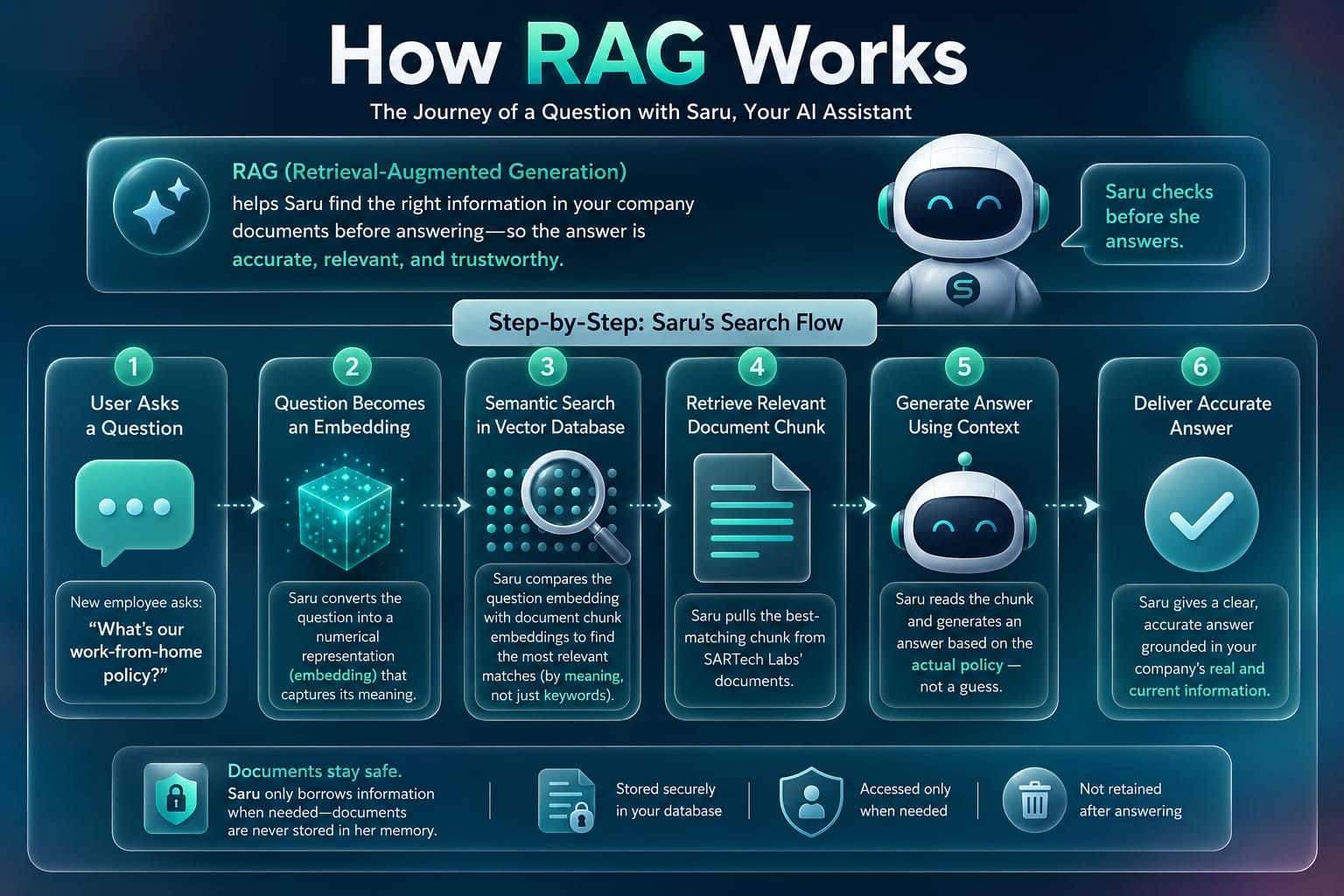
That's RAG in a sentence: Saru checks before she answers.
How RAG Works
Here's what actually happens when a new employee asks Saru, "What's our work-from-home policy?"
Before this moment, SARTECH Labs documents were already broken into smaller pieces, a process called chunking.
Instead of searching one giant policy manual, Saru works with smaller, focused sections, which makes retrieval faster and more accurate.
When the question comes in, Saru converts it into an embedding, a numerical representation of what the question means, not just the words in it.
Each document chunk has an embedding too, created the same way when the documents were first processed.
There are different ways to search using these embeddings. A keyword search looks for exact word matches. So if the employee asks about "WFH" but the document only says "remote work," a keyword search might miss it entirely.
A semantic search is smarter: it compares meaning, not just words, so it finds the right chunk even when the wording is different.
This is the kind of search RAG typically relies on. Once Saru finds the closest matching chunk, she pulls the actual policy text from it and uses that. Not a guess, to answer the question.
Picture this: You're driving somewhere new, trusting your GPS completely. It confidently tells you to turn right in 500 meters. You turn and hit a dead end. Construction closed that road two months ago. Your GPS wasn't lying to you. It just hadn't checked for updates before giving you an answer.
AI can do the exact same thing.
The AI tools you use every day ChatGPT, Gemini, Claude and more can hallucinate. Their answers sound confident, even correct, but they may not be factual.
Say you work at a company. The AI tools you use have no idea about your company's private documents, internal policies, technical details, or recently updated information. So they hallucinate, giving answers that sound right but aren't. That leads to mis-information.
This is where “RAG: Retrieval-Augmented Generation” comes in.
From the name, you'd think it's something big and complicated. It's not.
What RAG Actually Is
Here's a simple way to understand RAG. Say SARTECH Labs has an AI assistant. Let's call it "Saru", that helps new employees with questions. Someone asks Saru,"What's our current work-from-home policy?"
Without RAG, Saru would just take a guess, based on what most companies usually do. Sounds fine, but it might be totally wrong for SARTECH Labs.
With RAG, Saru actually looks up SARTECH Labs real policy document first, finds the right section, and then answers based on that, not a guess.
That's RAG in a sentence: Saru checks before she answers.
How RAG Works
Here's what actually happens when a new employee asks Saru, "What's our work-from-home policy?"
Before this moment, SARTECH Labs documents were already broken into smaller pieces, a process called chunking.
Instead of searching one giant policy manual, Saru works with smaller, focused sections, which makes retrieval faster and more accurate.
When the question comes in, Saru converts it into an embedding, a numerical representation of what the question means, not just the words in it.
Each document chunk has an embedding too, created the same way when the documents were first processed.
There are different ways to search using these embeddings. A keyword search looks for exact word matches. So if the employee asks about "WFH" but the document only says "remote work," a keyword search might miss it entirely.
A semantic search is smarter: it compares meaning, not just words, so it finds the right chunk even when the wording is different.
This is the kind of search RAG typically relies on. Once Saru finds the closest matching chunk, she pulls the actual policy text from it and uses that. Not a guess, to answer the question.
Why This Matters
Ready to Get Started?
Learning AI: Visit www.sartechlabs.com for AI courses/workshops in Malayalam and English, taught by Global AI experts.
Adopting AI in your business:
Visit www.sartechlabsbusiness.com or email info@sartechlabs.com.
What About Privacy?
Here's a question worth asking: when Saru looks up SARTECH Labs policy documents, does that mean those documents are now training the AI?
No. Saru just borrows the information for a moment, answers the question, and doesn't keep it. Think of it like Saru quickly checking a filing cabinet, not memorizing it.
There's a real difference between training and RAG.
Training means permanently teaching the AI new things, a slow process usually done only by the company that built the model. RAG is different. SARTECH Labs documents stay locked in their own database.
Saru just retrieves the relevant piece when needed, uses it to answer that one question, and moves on. Nothing gets absorbed into the AI's permanent memory.
Privacy still depends on setup, though. If you're using a third-party AI tool, it's worth checking how long they store your data. If everything runs on your own private system, your documents usually never leave it. And a good RAG system also makes sure Saru only pulls up documents someone is actually allowed to see.
Want to Go Deeper?
Understanding RAG is one thing, building with it is another. If you're curious about how to actually design and implement RAG systems, check out SARTECH Labs course, “RAG: From Documents to AI Chatbots”
[Link to course: https://www.sartechlabs.com/course/introduction-to-rag-retrieval-augmented-generation]
And this is just the starting point. RAG isn't just a concept, it's something we use to solve real problems for real businesses.
In the next blog, we'll look at how SARTECH Labs applies RAG in actual projects, and what it can do for your business.
Learning AI: Visit www.sartechlabs.com for AI courses/workshops in Malayalam and English, taught by Global AI experts.
Adopting AI in your business:
Visit www.sartechlabsbusiness.com or email info@sartechlabs.com.
What About Privacy?
Here's a question worth asking: when Saru looks up SARTECH Labs policy documents, does that mean those documents are now training the AI?
No. Saru just borrows the information for a moment, answers the question, and doesn't keep it. Think of it like Saru quickly checking a filing cabinet, not memorizing it.
There's a real difference between training and RAG.
Training means permanently teaching the AI new things, a slow process usually done only by the company that built the model. RAG is different. SARTECH Labs documents stay locked in their own database.
Saru just retrieves the relevant piece when needed, uses it to answer that one question, and moves on. Nothing gets absorbed into the AI's permanent memory.
Privacy still depends on setup, though. If you're using a third-party AI tool, it's worth checking how long they store your data. If everything runs on your own private system, your documents usually never leave it. And a good RAG system also makes sure Saru only pulls up documents someone is actually allowed to see.
Want to Go Deeper?
Understanding RAG is one thing, building with it is another. If you're curious about how to actually design and implement RAG systems, check out SARTECH Labs course, “RAG: From Documents to AI Chatbots”
[Link to course: https://www.sartechlabs.com/course/introduction-to-rag-retrieval-augmented-generation]
And this is just the starting point. RAG isn't just a concept, it's something we use to solve real problems for real businesses.
In the next blog, we'll look at how SARTECH Labs applies RAG in actual projects, and what it can do for your business.