
Graph Engineering: The Next Evolution in Building Intelligent AI Agent Systems
Aug 2
/
Sartech Labs
The way we build AI systems has evolved rapidly over the past few years. In 2023, the focus was on Prompt Engineering, crafting better prompts to improve AI responses. As organizations began integrating proprietary data into AI applications, Context Engineering emerged to ensure models had access to the right information. More recently, the rise of autonomous AI agents introduced Loop Engineering, where agents plan, execute, verify, and refine their own actions.
Today, the industry is entering its next phase. Rather than relying on a single AI agent, organizations are building multi-agent systems where specialized agents collaborate to solve complex business problems. Frameworks such as LangGraph, Google Agent Development Kit (ADK), Microsoft AutoGen GraphFlow, OpenAI Agents SDK, and CrewAI are accelerating this shift by making multi-agent orchestration more accessible.
As these systems grow in complexity, designing how agents communicate, coordinate, share information, and make decisions is becoming an engineering discipline of its own. This emerging discipline is known as Graph Engineering.
In this article, we'll explore what Graph Engineering is, why it has emerged, how it differs from Prompt, Context, and Loop Engineering, and why it is poised to become a foundational approach for building enterprise AI systems.
Today, the industry is entering its next phase. Rather than relying on a single AI agent, organizations are building multi-agent systems where specialized agents collaborate to solve complex business problems. Frameworks such as LangGraph, Google Agent Development Kit (ADK), Microsoft AutoGen GraphFlow, OpenAI Agents SDK, and CrewAI are accelerating this shift by making multi-agent orchestration more accessible.
As these systems grow in complexity, designing how agents communicate, coordinate, share information, and make decisions is becoming an engineering discipline of its own. This emerging discipline is known as Graph Engineering.
In this article, we'll explore what Graph Engineering is, why it has emerged, how it differs from Prompt, Context, and Loop Engineering, and why it is poised to become a foundational approach for building enterprise AI systems.
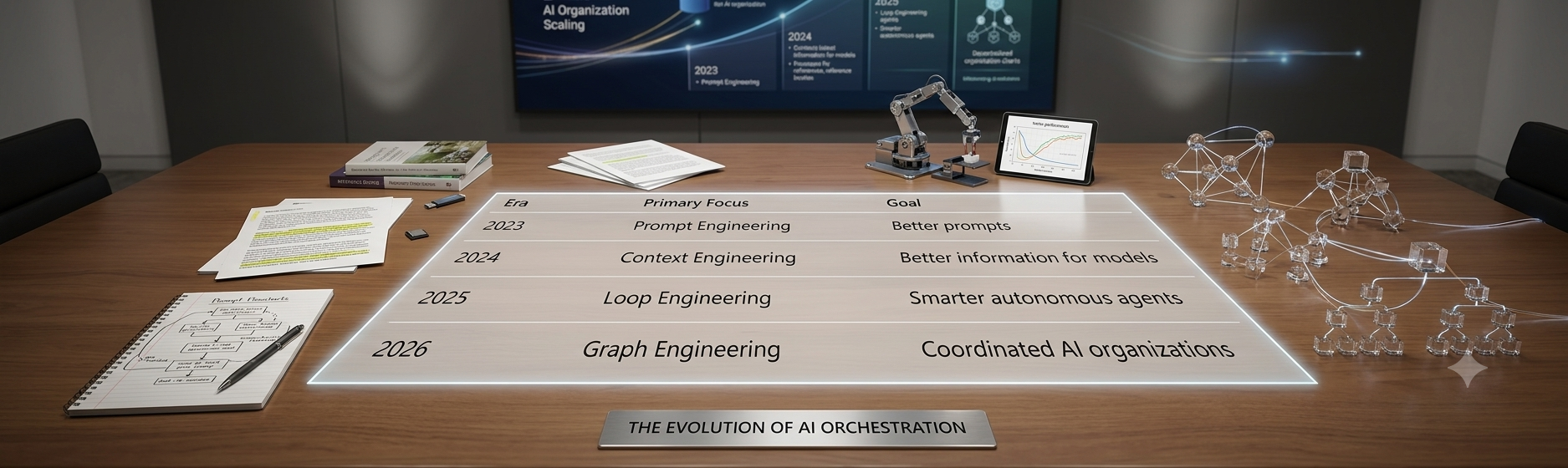
Why Loop Engineering Is No Longer Enough: The Need for Graph Engineering
Loop Engineering marked a significant advancement in the evolution of AI systems. It moved beyond the traditional approach of issuing a single prompt and expecting a complete response by enabling AI agents to work through an iterative cycle of planning, execution, verification, and refinement. This allowed AI systems to solve more complex problems by reasoning through multiple steps, using external tools, evaluating their own outputs, and correcting mistakes before producing a final result.
For many use cases, this approach has proven highly effective. A single AI agent can autonomously perform tasks such as document summarization, report generation, code development, customer support, data analysis, and information retrieval. By continuously evaluating its progress and adjusting its actions, Loop Engineering enables AI systems to produce more reliable and accurate outcomes than traditional prompt-based interactions.
However, as organizations increasingly adopt AI for enterprise-scale operations, the limitations of relying on a single autonomous agent have become more apparent. Modern business processes are rarely simple or linear. They often involve multiple interconnected activities, different types of expertise, interactions with numerous data sources, and collaboration across various functions. Expecting one AI agent to manage every aspect of such workflows introduces significant complexity.
As responsibilities increase, a single reasoning loop becomes more difficult to manage. The agent must maintain extensive context throughout the execution, make decisions across unrelated domains, coordinate multiple tools, handle failures gracefully, and ensure that every stage of the workflow produces consistent results. This increases computational overhead, makes debugging more challenging, and complicates maintenance as the system grows.
Scalability also becomes a concern. Enterprise AI systems must continuously evolve by incorporating new capabilities, integrating additional tools, adapting to changing business requirements, and supporting increasingly sophisticated workflows. When all responsibilities are concentrated within one autonomous loop, extending or modifying the system often requires significant redesign rather than incremental improvements.
Another important challenge is specialization. While modern large language models possess broad general knowledge, they are not equally effective at every task. Some activities require deep reasoning, others require structured data processing, compliance verification, software execution, or interaction with external systems. Designing one agent to perform all these responsibilities efficiently often results in unnecessary complexity and reduced reliability.
Furthermore, enterprise environments demand greater levels of transparency, governance, and control than consumer AI applications. Organizations need to understand how decisions are made, monitor individual stages of execution, isolate failures, introduce approval mechanisms, and ensure compliance with internal policies and industry regulations. Achieving this level of observability becomes increasingly difficult when all decision-making occurs within a single autonomous loop.
These challenges highlight that while Loop Engineering remains an essential foundation for building intelligent AI agents, it is no longer sufficient for designing large-scale, collaborative AI systems. The next stage in the evolution of AI engineering requires an architectural approach that enables specialization, modularity, coordination, and scalability. This need has led to the emergence of Graph Engineering, which focuses on organizing multiple specialized AI components into structured workflows capable of solving complex enterprise problems more efficiently than a single autonomous agent alone.
Rather than replacing Loop Engineering, Graph Engineering builds upon its strengths. The principles of planning, reasoning, verification, and tool usage continue to play a vital role, but they are applied within a broader architectural framework designed to support collaboration, flexibility, and long-term maintainability. This shift represents the natural progression of AI system design as organizations move from deploying individual AI agents to building interconnected AI ecosystems.
For many use cases, this approach has proven highly effective. A single AI agent can autonomously perform tasks such as document summarization, report generation, code development, customer support, data analysis, and information retrieval. By continuously evaluating its progress and adjusting its actions, Loop Engineering enables AI systems to produce more reliable and accurate outcomes than traditional prompt-based interactions.
However, as organizations increasingly adopt AI for enterprise-scale operations, the limitations of relying on a single autonomous agent have become more apparent. Modern business processes are rarely simple or linear. They often involve multiple interconnected activities, different types of expertise, interactions with numerous data sources, and collaboration across various functions. Expecting one AI agent to manage every aspect of such workflows introduces significant complexity.
As responsibilities increase, a single reasoning loop becomes more difficult to manage. The agent must maintain extensive context throughout the execution, make decisions across unrelated domains, coordinate multiple tools, handle failures gracefully, and ensure that every stage of the workflow produces consistent results. This increases computational overhead, makes debugging more challenging, and complicates maintenance as the system grows.
Scalability also becomes a concern. Enterprise AI systems must continuously evolve by incorporating new capabilities, integrating additional tools, adapting to changing business requirements, and supporting increasingly sophisticated workflows. When all responsibilities are concentrated within one autonomous loop, extending or modifying the system often requires significant redesign rather than incremental improvements.
Another important challenge is specialization. While modern large language models possess broad general knowledge, they are not equally effective at every task. Some activities require deep reasoning, others require structured data processing, compliance verification, software execution, or interaction with external systems. Designing one agent to perform all these responsibilities efficiently often results in unnecessary complexity and reduced reliability.
Furthermore, enterprise environments demand greater levels of transparency, governance, and control than consumer AI applications. Organizations need to understand how decisions are made, monitor individual stages of execution, isolate failures, introduce approval mechanisms, and ensure compliance with internal policies and industry regulations. Achieving this level of observability becomes increasingly difficult when all decision-making occurs within a single autonomous loop.
These challenges highlight that while Loop Engineering remains an essential foundation for building intelligent AI agents, it is no longer sufficient for designing large-scale, collaborative AI systems. The next stage in the evolution of AI engineering requires an architectural approach that enables specialization, modularity, coordination, and scalability. This need has led to the emergence of Graph Engineering, which focuses on organizing multiple specialized AI components into structured workflows capable of solving complex enterprise problems more efficiently than a single autonomous agent alone.
Rather than replacing Loop Engineering, Graph Engineering builds upon its strengths. The principles of planning, reasoning, verification, and tool usage continue to play a vital role, but they are applied within a broader architectural framework designed to support collaboration, flexibility, and long-term maintainability. This shift represents the natural progression of AI system design as organizations move from deploying individual AI agents to building interconnected AI ecosystems.
What is Graph Engineering?
Graph Engineering is the practice of designing AI systems as interconnected graphs of specialized agents or processing nodes rather than relying on a single monolithic agent. A graph typically consists of three fundamental components:
1. Nodes
Each node performs one specific responsibility. Examples include: Research Agent Planner Code Generator Reviewer Security Validator Documentation Writer Human Approval Node Rather than one AI attempting everything, every node becomes an expert.
2. Edges
Edges determine how work flows between nodes. Examples include: Sequential execution Parallel execution Conditional branching Retry paths Human intervention Approval gates Edges transform independent agents into an organized workflow.
3. Shared State
Every node reads from and updates a common state. The shared state may include: conversation history retrieved knowledge generated artifacts execution logs task status intermediate outputs Instead of repeatedly passing prompts, agents collaborate using shared context.
This node-edge-state architecture is what differentiates Graph Engineering from traditional AI workflows.
1. Nodes
Each node performs one specific responsibility. Examples include: Research Agent Planner Code Generator Reviewer Security Validator Documentation Writer Human Approval Node Rather than one AI attempting everything, every node becomes an expert.
2. Edges
Edges determine how work flows between nodes. Examples include: Sequential execution Parallel execution Conditional branching Retry paths Human intervention Approval gates Edges transform independent agents into an organized workflow.
3. Shared State
Every node reads from and updates a common state. The shared state may include: conversation history retrieved knowledge generated artifacts execution logs task status intermediate outputs Instead of repeatedly passing prompts, agents collaborate using shared context.
This node-edge-state architecture is what differentiates Graph Engineering from traditional AI workflows.
Core Principles of Graph Engineering
At its core, Graph Engineering is built upon the principle of specialization. Rather than expecting a single AI agent to perform every task, from planning and research to execution and quality assurance, the work is distributed across multiple specialized agents. Each agent is designed with a clearly defined responsibility and can be independently developed, tested, and improved. This modular approach closely resembles how successful organizations structure human teams, where specialists collaborate instead of relying on a single individual to handle every aspect of a project.
Another defining characteristic of Graph Engineering is parallel execution. Traditional AI workflows often perform tasks sequentially, meaning each step must be completed before the next one begins. In contrast, graph-based architectures allow independent tasks to run simultaneously whenever there are no dependencies between them. For example, while one agent gathers market intelligence, another can analyze customer data, and a third can review regulatory requirements. By executing these activities in parallel, organizations can significantly reduce response times while improving the overall efficiency of their AI systems.
Shared state management is another essential element of Graph Engineering. Instead of repeatedly passing large prompts from one agent to another, every node in the graph interacts with a common state that stores the current progress of the workflow. This shared state may contain retrieved documents, intermediate analyses, generated code, execution history, user preferences, or any other contextual information required by downstream agents. Maintaining a centralized state not only reduces redundancy but also ensures that every agent operates with the same understanding of the problem, resulting in greater consistency and fewer communication errors.
Graph Engineering also places considerable emphasis on explicit orchestration. Rather than allowing a language model to decide every step autonomously, engineers define the relationships between agents using deterministic workflow logic wherever appropriate. The graph specifies which agents should execute, under what conditions branching should occur, when tasks should be retried, and when human intervention is required. This makes enterprise AI systems significantly more predictable, auditable, and easier to govern than purely autonomous agent architectures.
Finally, Graph Engineering naturally accommodates human-in-the-loop decision making. While AI agents can automate repetitive tasks and perform complex analyses, critical business decisions often require human oversight. Graph-based workflows can incorporate approval nodes where managers, compliance officers, or subject matter experts review the AI's outputs before the workflow proceeds. This capability is particularly valuable in highly regulated industries such as healthcare, banking, insurance, and government, where transparency and accountability are as important as automation itself.
Another defining characteristic of Graph Engineering is parallel execution. Traditional AI workflows often perform tasks sequentially, meaning each step must be completed before the next one begins. In contrast, graph-based architectures allow independent tasks to run simultaneously whenever there are no dependencies between them. For example, while one agent gathers market intelligence, another can analyze customer data, and a third can review regulatory requirements. By executing these activities in parallel, organizations can significantly reduce response times while improving the overall efficiency of their AI systems.
Shared state management is another essential element of Graph Engineering. Instead of repeatedly passing large prompts from one agent to another, every node in the graph interacts with a common state that stores the current progress of the workflow. This shared state may contain retrieved documents, intermediate analyses, generated code, execution history, user preferences, or any other contextual information required by downstream agents. Maintaining a centralized state not only reduces redundancy but also ensures that every agent operates with the same understanding of the problem, resulting in greater consistency and fewer communication errors.
Graph Engineering also places considerable emphasis on explicit orchestration. Rather than allowing a language model to decide every step autonomously, engineers define the relationships between agents using deterministic workflow logic wherever appropriate. The graph specifies which agents should execute, under what conditions branching should occur, when tasks should be retried, and when human intervention is required. This makes enterprise AI systems significantly more predictable, auditable, and easier to govern than purely autonomous agent architectures.
Finally, Graph Engineering naturally accommodates human-in-the-loop decision making. While AI agents can automate repetitive tasks and perform complex analyses, critical business decisions often require human oversight. Graph-based workflows can incorporate approval nodes where managers, compliance officers, or subject matter experts review the AI's outputs before the workflow proceeds. This capability is particularly valuable in highly regulated industries such as healthcare, banking, insurance, and government, where transparency and accountability are as important as automation itself.
Popular Frameworks Supporting Graph Engineering
Several frameworks already provide the building blocks for graph-based AI systems.
LangGraph
One of the most widely adopted orchestration frameworks for building stateful AI agents using graph structures. Ideal for: agent workflows branching logic long-running processes shared memory.
Google Agent Development Kit (ADK)
Google's framework introduces structured graph-based orchestration with sequential, parallel, routing, and looping workflows.
Microsoft AutoGen GraphFlow
Supports multi-agent collaboration where agents coordinate through defined graph relationships. Although the term "Graph Engineering" is new, these frameworks demonstrate that graph-oriented orchestration has been developing for some time.
LangGraph
One of the most widely adopted orchestration frameworks for building stateful AI agents using graph structures. Ideal for: agent workflows branching logic long-running processes shared memory.
Google Agent Development Kit (ADK)
Google's framework introduces structured graph-based orchestration with sequential, parallel, routing, and looping workflows.
Microsoft AutoGen GraphFlow
Supports multi-agent collaboration where agents coordinate through defined graph relationships. Although the term "Graph Engineering" is new, these frameworks demonstrate that graph-oriented orchestration has been developing for some time.
The Five Stages of Agentic Engineering
The rapid evolution of AI development can be viewed as a progression through five distinct engineering stages. Each stage addresses a different challenge in building increasingly capable AI systems. Rather than replacing one another, these stages build upon the foundations established by the previous ones.
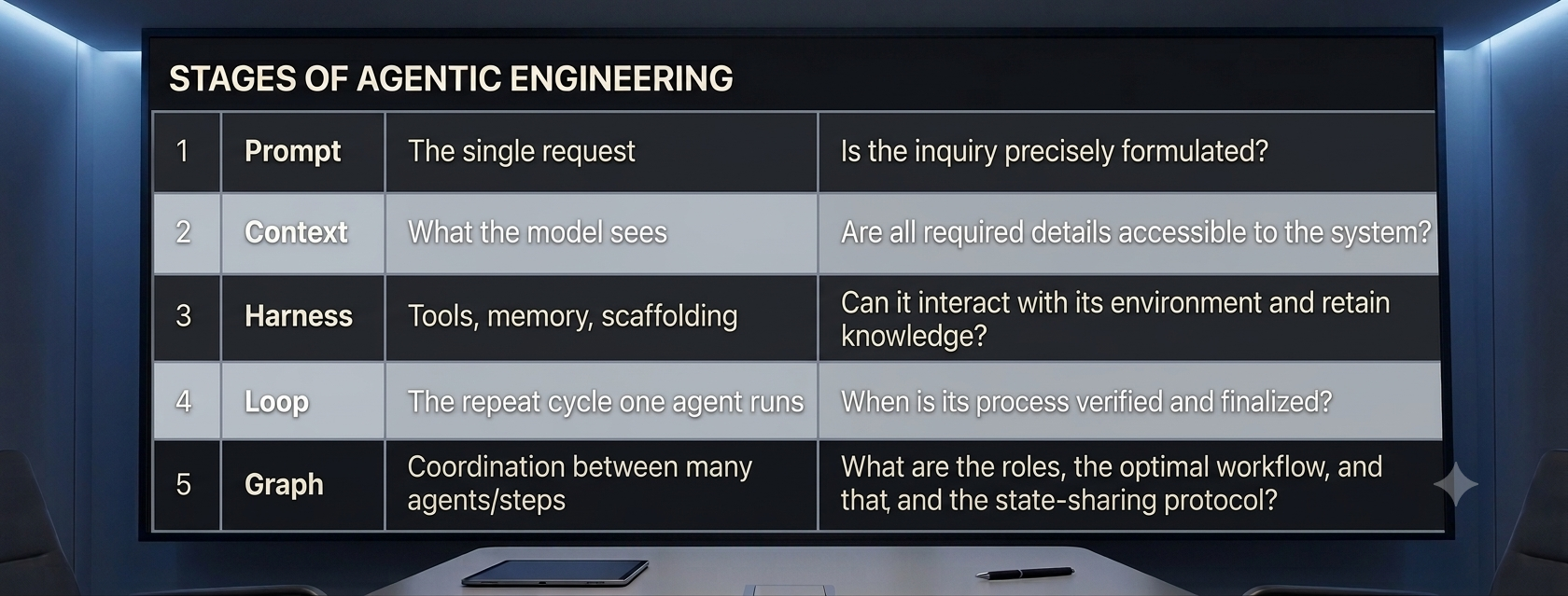
Graph Engineering should not be viewed as a replacement for Prompt, Context, Harness, or Loop Engineering. Instead, it builds upon these earlier disciplines, combining them into a coordinated architecture for designing collaborative AI systems.
- Prompt Engineering focuses on crafting effective instructions for language models. The primary question is: Is the request clearly formulated so the model understands the task?
- Context Engineering ensures the model has access to the right information. This includes retrieved documents, memory, user preferences, and external knowledge required to generate accurate responses.
- Harness Engineering extends AI systems beyond the language model by integrating tools, memory, APIs, and execution environments. It enables agents to interact with external systems instead of only generating text.
- Loop Engineering introduces iterative reasoning, allowing an agent to plan, execute, verify, and refine its work until a satisfactory outcome is achieved.
- Graph Engineering expands this concept further by orchestrating multiple specialized agents into a coordinated workflow. Instead of optimizing the behavior of a single agent, the focus shifts to designing how many agents communicate, share state, divide responsibilities, and collectively solve complex problems.
As AI systems become more sophisticated, engineering challenges naturally shift from improving individual model interactions to designing reliable, scalable, and collaborative AI architectures. Graph Engineering represents the latest step in this evolution.
What Graph Engineers Actually Build
Graph Engineering is not about creating graph databases or knowledge graphs. It is the discipline of designing collaborative AI systems where multiple specialized agents coordinate to solve complex problems. Instead of optimizing the behavior of a single AI agent, Graph Engineers focus on designing the architecture that enables many agents to work together effectively.
The work of a Graph Engineer extends well beyond prompt writing. Their responsibilities include defining the roles of specialized agents, designing how information flows between them, managing shared state, integrating external tools, and ensuring the entire workflow remains reliable, observable, and scalable. In many ways, the role resembles that of a software architect, but for AI-native systems.
Typical responsibilities include:
As enterprise AI systems become increasingly sophisticated, Graph Engineers are shifting their focus from building smarter individual agents to designing intelligent systems of collaboration. The challenge is no longer how one agent should think, but how many specialized agents should coordinate, communicate, and collectively solve problems at scale.
The work of a Graph Engineer extends well beyond prompt writing. Their responsibilities include defining the roles of specialized agents, designing how information flows between them, managing shared state, integrating external tools, and ensuring the entire workflow remains reliable, observable, and scalable. In many ways, the role resembles that of a software architect, but for AI-native systems.
Typical responsibilities include:
- Defining agent roles by specifying each agent's responsibilities, available tools, permissions, and the context it owns.
- Designing handoff protocols so that outputs from one agent can be consumed efficiently by another without repeatedly transferring unnecessary context.
- Building work graphs that determine which agents should execute, which tasks can run in parallel, where conditional routing is required, and when workflows should loop or terminate.
- Managing shared state so every agent operates on a consistent view of the workflow while minimizing redundant information exchange.
- Integrating enterprise systems such as APIs, databases, retrieval pipelines, messaging platforms, and business applications into the graph.
- Implementing human approval checkpoints for sensitive, regulated, or business-critical decisions.
- Designing failure recovery strategies, including retries, fallback agents, escalation paths, and graceful error handling.
- Building observability through execution tracing, logging, token usage analysis, latency monitoring, and workflow visualization to understand how the graph behaves in production.
- Optimizing the graph for cost, performance, reliability, and maintainability by selecting appropriate models, execution strategies, and orchestration patterns.
As enterprise AI systems become increasingly sophisticated, Graph Engineers are shifting their focus from building smarter individual agents to designing intelligent systems of collaboration. The challenge is no longer how one agent should think, but how many specialized agents should coordinate, communicate, and collectively solve problems at scale.
Graph Engineering Checklist
Before You Start
✔ Can this problem be solved by a single agent with a well-designed loop?
✔ Does each proposed node represent a genuinely different responsibility, model, tool, or permission level?
✔ Can you sketch the workflow on paper before writing code?
Designing the Graph
✔ Identify specialized nodes.
✔ Define the execution flow (sequential, parallel, conditional, loops).
✔ Design the shared state and specify which nodes can read and write each part.
✔ Keep nodes focused on a single responsibility.
Building the Workflow
✔ Connect the required tools, APIs, and data sources. ✔ Add independent reviewer nodes instead of self-verification.
✔ Introduce human approval where necessary.
✔ Isolate failures so one node can retry without restarting the entire graph.
Production Readiness
✔ Use an established orchestration framework instead of building your own runtime.
✔ Define limits for execution time, iterations, and token usage.
✔ Monitor cost, latency, quality, and reliability.
✔ Keep the graph as simple as possible—every node should justify its existence.
✔ Can this problem be solved by a single agent with a well-designed loop?
✔ Does each proposed node represent a genuinely different responsibility, model, tool, or permission level?
✔ Can you sketch the workflow on paper before writing code?
Designing the Graph
✔ Identify specialized nodes.
✔ Define the execution flow (sequential, parallel, conditional, loops).
✔ Design the shared state and specify which nodes can read and write each part.
✔ Keep nodes focused on a single responsibility.
Building the Workflow
✔ Connect the required tools, APIs, and data sources. ✔ Add independent reviewer nodes instead of self-verification.
✔ Introduce human approval where necessary.
✔ Isolate failures so one node can retry without restarting the entire graph.
Production Readiness
✔ Use an established orchestration framework instead of building your own runtime.
✔ Define limits for execution time, iterations, and token usage.
✔ Monitor cost, latency, quality, and reliability.
✔ Keep the graph as simple as possible—every node should justify its existence.